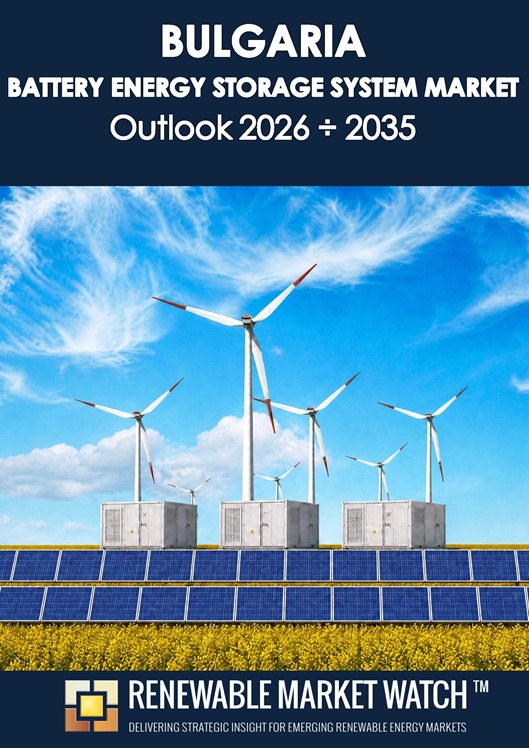
/SOFIA, BULGARIA, July 9, 2026, 9:00 CEST, RENEWABLE MARKET WATCH™/
Over the past three years, Bulgaria has transformed from a marginal player to the most dynamic battery energy storage (BESS) market in Europe, driven by targeted and effective support measures. Installed and contracted capacity has already surpassed the country’s 2030 policy target by four years. Private and EU investment has accelerated beyond expectations, placing Bulgaria among the European BESS leaders. The main drivers—rapid solar PV expansion, subsidies from the National Recovery and Resilience Plan (NRRP), and urgent grid balancing needs—can also help address upcoming challenges, including declining arbitrage margins, transmission constraints, and operating without subsidies. In 2026, Bulgaria became a global leader in the share of operating power from battery energy storage systems, exceeding 16% of the electricity system. The country is among the top 3 BESS markets in Europe. As of the end of H1 2026, Bulgaria’s cumulative installed storage capacity exceeded Germany’s utility-scale capacity.

Chart 1: Bulgarian Power Generation Capacity by Source Type 2024, Source: Renewable Market Watch
In the last few years, Bulgaria has been the focus of investors’ interest. The political stability and predictability stemming from NATO membership and EU accession, the stable economic outlook, and the country’s improving credit rating following its acceptance into the Eurozone from 1 January 2026 were among the factors attracting investors’ interest in the Bulgarian BESS market. Bulgaria holds a long-term sovereign credit rating of BBB+ (with a positive outlook) from S&P Global and BBB+ (stable outlook) from Fitch Ratings. Moody’s evaluates the country at Baa1 with a stable outlook. These investment-grade assessments are supported by Bulgaria’s solid public finances, strong external balance sheet, and deeper integration into the EU.
Where the Market Stands Today (Mid-2026)
At the end of June 2026, the country’s installed BESS power capacity is roughly 3.7-3.9 GWac, according to TSO data cited in the recently published study Bulgaria Battery Energy Storage System (BESS) Market Outlook 2026 – 2035. This is more than double the level at the start of the year, with over 11.7 GWh of energy storage capacity — enough to charge or discharge at full power for around three hours. Renewable Market Watch™ ranks Bulgaria among the top three most attractive European markets for energy storage projects in the yearly updated “Attractiveness index for battery energy storage system (BESS) in Europe in 2026”.
According to the Bulgaria Battery Energy Storage System (BESS) Market Outlook 2026 – 2035, Bulgarian Battery storage capacity surged from less than 190 MWh at the end of 2024 to almost 11,700 MWh in mid-2026, making Bulgaria the EU’s fastest-growing BESS market for newly installed capacity. Over € 2 billion has been invested in the BESS sector over the past two years, combining private capital and EU subsidies.
Main Growth Drivers of the Bulgarian BESS Market
The Bulgarian solar power market has been experiencing significant growth since 2021. As a result of high economic growth over the last 5 years, industrialisation, and urbanisation, the demand for new energy generation sources to replace coal-based power plants in Bulgaria has been increasing. By the middle of 2026, Bulgaria had a cumulative installed solar capacity of over 6,870 MW (6.87 GW), representing an increase of 5,587 MW (5.58 GW) compared to 2021. Bulgaria installed over 1 GW of solar for the third consecutive year in 2025, and, according to the recently published study, the Bulgaria Battery Energy Storage System (BESS) Market Outlook 2026 – 2035, is forecast to add over 2 GW of new capacity in 2026, driven by a pipeline of large-scale utility projects.
The rapid growth of solar PV capacity in Bulgaria and the damages in the Chaira Pumped Storage Hydro Power Plant (operating at less than 25% of its 864 MW capacity between 2020 and 2025) required a corresponding increase in battery storage capacity to prevent grid imbalances. Solar electricity cannibalisation established the ground for the growth of the Bulgarian BESS market. Since 2024, in Bulgaria, midday wholesale prices have collapsed into negative territory, followed by evening price spikes as high as €450/MWh.
Amendments to the Energy Act in 2023/2024 formally defined energy storage systems, and, crucially, 2024 amendments to the Energy Act and Electricity Trading Rules recognised energy storage facilities as independent market participants for the first time. This allows BESS projects to operate as standalone systems or co-located with renewable generation installations, enabling them to participate in energy trading (day-ahead and intraday and grid balancing services (aFRR and mFRR).
Ordinance No. 6 (State Gazette No. 28/2024) introduced a simplified grid connection procedure for BESS projects. A particularly important provision is that no double network fees apply — access and transmission prices are paid only on the net difference between electricity drawn from and returned to the grid. RES/storage projects up to 20 MW are also exempt from electricity production licensing requirements.
In September 2024, the Energy and Water Regulatory Commission (EWRC) introduced mandatory financial safeguards requiring investors to provide a deposit or bank guarantee of BGN 50,000 (~€25,565) per MWh of planned capacity before approval for grid connection. This was designed to prevent speculative capacity reservations and ensure serious project development. These favourable legislative changes create highly profitable revenue streams, including arbitrage, capacity payments, and balancing-market income, and have made the economics of Bulgarian BESS plants attractive even in thinner arbitrage spreads.
International BESS technology suppliers (Huawei, Sungrow, TBEA, Hithium, CATL, Jinko ESS, Sineng, Kehua and others) have established a local presence, contributing significantly to the highly optimised supply chain, while at least several Bulgarian manufacturers have begun producing BESS equipment. Therefore, Bulgaria is expected to shift from an importer to an exporter of battery storage products for the European and other emerging international markets.
On one of the most important information market drivers, were successfully completed tenders for the National Recovery and Resilience Plan (NRRP) for RES + BESS installations and for standalone BESS installations in 2023 – 2025, resulting in the award of over 14 GWh of storage capacity. There is one successfully completed tender (BG-RRP-4.032 and BG-RRP-4.033) for RES + BESS installations with a budget of 273.7 million. Additionally, RESTORE+ tendered 10,000 MWh of standalone BESS installations with a EUR 614 million budget, while the latest tender (RESTORE-2) allocated EUR 117.6 million for 4,000 MW of standalone BESS installations (more than double the initially planned 1,900 MWh).
Key Bulgarian BESS Projects
Enery has officially commissioned the Nova Zagora Battery Energy Storage System (BESS), now recognised as the largest BESS facility in Central and Eastern Europe. Boasting a total storage capacity of 601.8 MWh and a power output of 150 MW, this landmark project represents a significant advancement in Bulgaria’s energy sector. The facility delivers key grid stabilisation services and plays a pivotal role in supporting the large-scale integration of renewable energy sources, positioning Bulgaria as a regional leader in energy transition.
Sunotec, a top-tier European integrator specialising in utility-scale solar and battery storage projects, has announced the closing of a structured equity investment from funds managed by Blackstone Tactical Opportunities. This strategic partnership is designed to accelerate Sunotec’s international growth trajectory, while bolstering its expertise in grid integration and advanced renewable energy solutions. Blackstone’s capital injection will fuel Sunotec’s growth across key European markets—including Germany, the United Kingdom, Scandinavia, and Southeast Europe—while empowering the company to broaden its service portfolio and develop complementary capabilities, such as large-scale grid infrastructure. The collaboration also aims to scale Sunotec’s hybrid renewable energy asset platform and deepen its commitment to sustainable infrastructure investments, positioning the company as a front-runner in next-generation energy systems.
The ContourGlobal Maritsa Battery Energy Storage System (BESS) is among the largest and most technologically advanced battery storage facilities in Bulgaria and the surrounding region. With a formidable power output of 202 megawatts (MW) and an impressive capacity of 500 megawatt-hours (MWh), this project is designed to enhance the stability and efficiency of the national electricity grid.
A new high-tech factory for the production of energy storage batteries was opened in Chelopechene by the Bulgarian company International Power Supply (IPS) in 2025. The newly opened factory began operations with an impressive annual production capacity of 3 gigawatt-hours (GWh), which is planned to be expanded to 5 GWh by the end of 2026. In addition, a second fully automated production facility is currently in the design and planning phase and, when completed, will bring the company’s total production capacity to a remarkable 15 GWh by the end of 2027.
Bulgarian BESS Market Development Trend to 2030
The use of BESS as standalone installations or as part of hybrid projects will be necessary not only to mitigate the volatility of renewable electricity production in Bulgaria, but also to reduce price fluctuations and more effectively manage peak loads on the grid. This ability to “move” energy throughout the day and night is essential for the stability of the electricity grid and for reducing dependence on reserve coal-fired power.
Bulgarian TSO (ESO EAD) can further improve grid stability by installing BESS plants at its own HV substations. In this way, TSO will gain directly controllable, ultra-fast-responding storage assets that compensate for the loss of synchronous inertia, provide multi-layered frequency and voltage support, strengthen weak grid nodes, and enhance system resilience — all without relying on market-based procurement that may not be available during critical events. This is particularly urgent given Bulgaria’s accelerating renewable buildout and the planned retirement of its coal fleet.

Chart 2: Electricity Generation and Load in Bulgaria by Generation Source Type (in per cent) on 8 July 2026 (00 07 h): Source TSO (ESO EAD)
Financial modelling cases presented in the Bulgaria Battery Energy Storage System (BESS) Market Outlook 2026 – 2035 show that standalone solar has not been bankable in Bulgaria since the beginning of 2025 without co-located storage or another appropriate trading and flexibility strategy. To continue the growth of this BESS market, Bulgaria will need to build additional grid infrastructure and increase the currently overloaded interconnection capacity with neighbouring markets while transforming the policy design to sustain the long-term stability of investments rather than the current speculative money flow.
With the expected full repair of the Chaira Pumped Storage Hydro Power Plant (864 MW of storage capacity) by mid-2027 and the planned new large-scale pumped-storage hydropower plant as a complement to existing BESS plants for flexible multi-hour and seasonal storage needs, Bulgaria is close to achieving its ambition of becoming a regional balancing hub for neighbouring markets.
The battery energy storage system (BESS) market in Bulgaria is expected to reach 5 GWac capacity by the end of 2026 and continue to grow through 2030 across the behind-the-meter (BTM) and front-of-the-meter (FTM) segments, according to the Renewable Market Watch™. Revenue models built and largely dependent on arbitrage between 2024 and 2026 will be difficult to sustain given the vast increase in Bulgarian storage capacity over the past three years. Between 2027 and 2030, more sophisticated multi-market trading strategies will be needed to enable BESS plant owners to generate stable cash flows. The end of subsidies in 2026 will put further pressure on market growth by 2030.
For more information and answers to your questions about the Bulgarian battery energy storage system (BESS) market and related content, you may read here: Bulgaria Battery Energy Storage System (BESS) Market Outlook 2026 – 2035
For a better understanding of the benefits of using our reports, you may read here: Benefit List – Reports of Renewable Market Watch – 2026
About Renewable Market Watch™
Renewable Market Watch™ delivers strategic insights into emerging renewable energy markets through its experienced research team and cutting-edge predictive analytics platform. We partner with our customers to provide research, data and consulting reports in areas appropriate to their specific requirements. Our primary focus is emerging renewable energy markets in Asian countries, Western Europe, Southern Europe, Balkan countries, Central and Eastern Europe, CIS states (the former Soviet Union), LATAM countries, and MENA countries. For more information about Renewable Market Watch™, please visit:
https://renewablemarketwatch.com/about-us